The Big Story
Quick Take:
-
Housing got substantially more affordable on a year-over-year basis in December.
-
Rates continue to fall, as lending markets price in lower long-term interest rates.
-
Inventory and sale metrics are roughly in line with what we were seeing around this time last year.
-
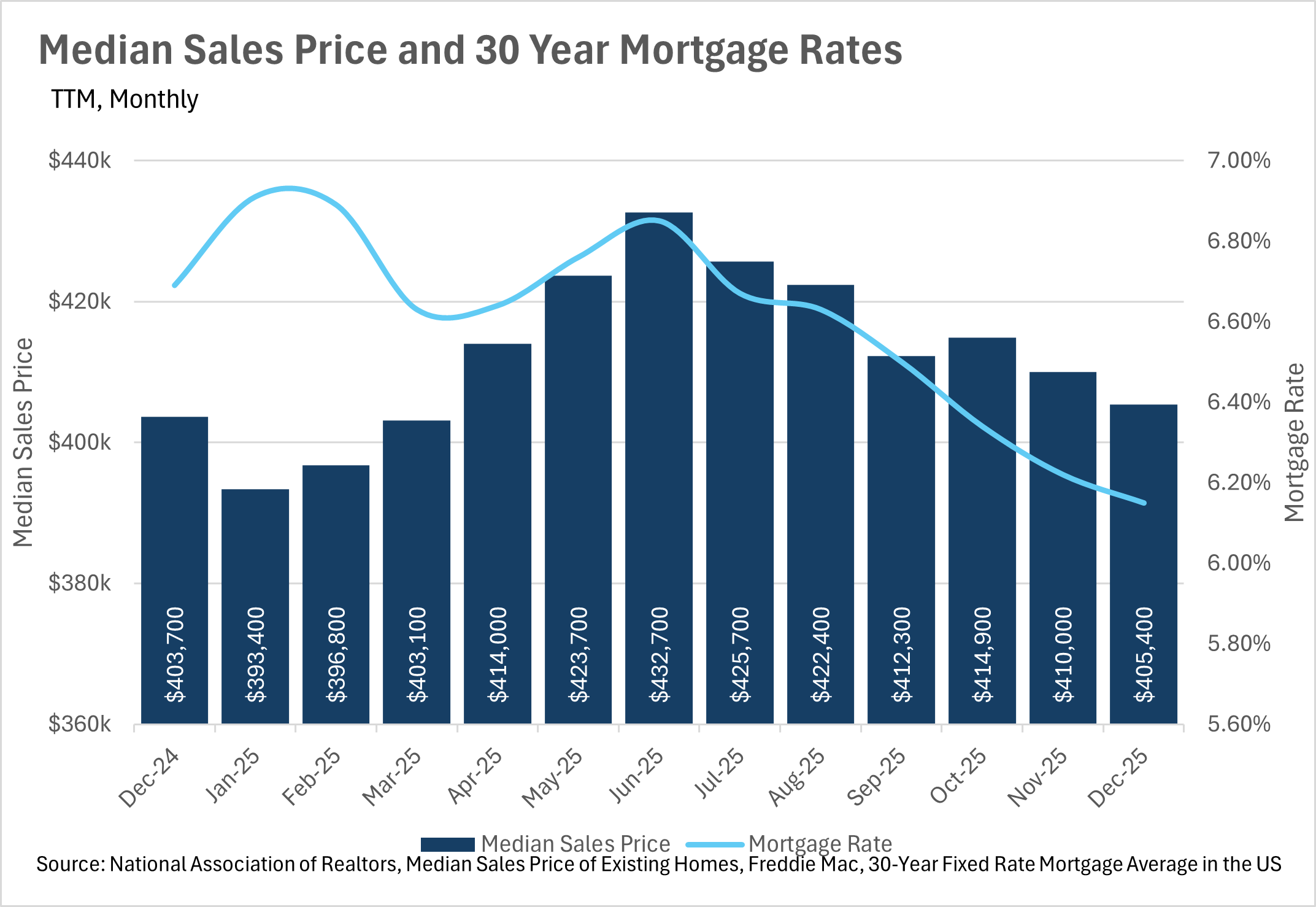
Despite the fact that we’ve seen interest rates come down quite a bit over the last year, median home sale prices are roughly in line with where they were last year!
Note: You can find the charts & graphs for the Big Story at the end of the following section.
*National Association of REALTORS® data is released two months behind, so we estimate the most recent month's data when possible and appropriate.
As interest rates fall, median monthly P&I payment has fallen too!
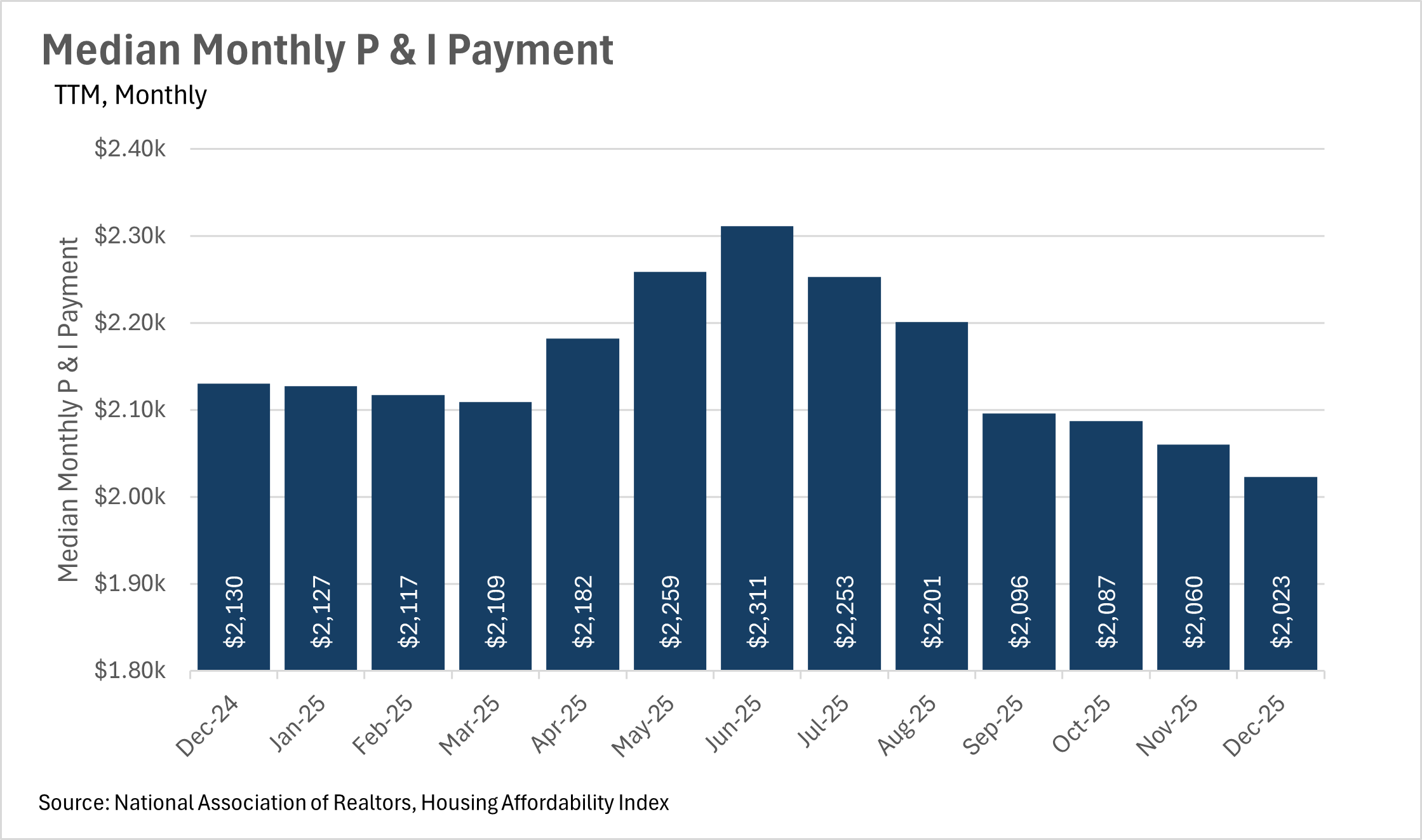
Interest rates have been in a downward cycle for quite some time, as the Federal Reserve has been lowering the federal funds rate. As you might expect, that means that the median monthly P&I payment has declined by quite a bit too. Right now, the median homeowner is paying $2,023 per month to service the P&I on their mortgage, which is down 5.02% from $2,130, just a year ago. This is great for the average American, as it means they have more money in their pocket to spend, or potentially save for their next move! In the beginning of December, the average 30-year mortgage rate was 6.15%, and has continued to fall since!
Mortgage rates are at the lowest level we’ve seen in quite some time!
Fortunately for home buyers and sellers, the lending markets are beginning to believe that interest rates will remain low in the near and medium term future. This has led interest rates to continue inching down almost every month. In the past few weeks, we’ve seen the average 30-year mortgage rate at the lowest level it’s been in the past three years, which is tremendous news for the housing market. Unfortunately though, it doesn’t seem like the Fed will lower rates during the next FOMC meeting, as CME FedWatch currently has the probability of a March rate cut at just 7.9% at the time this was written. However, if you extend your time horizon out a bit, it does seem like there’s a good chance we see a rate cut or two throughout the rest of the year.
Inventory and sale metrics are roughly in line with last year
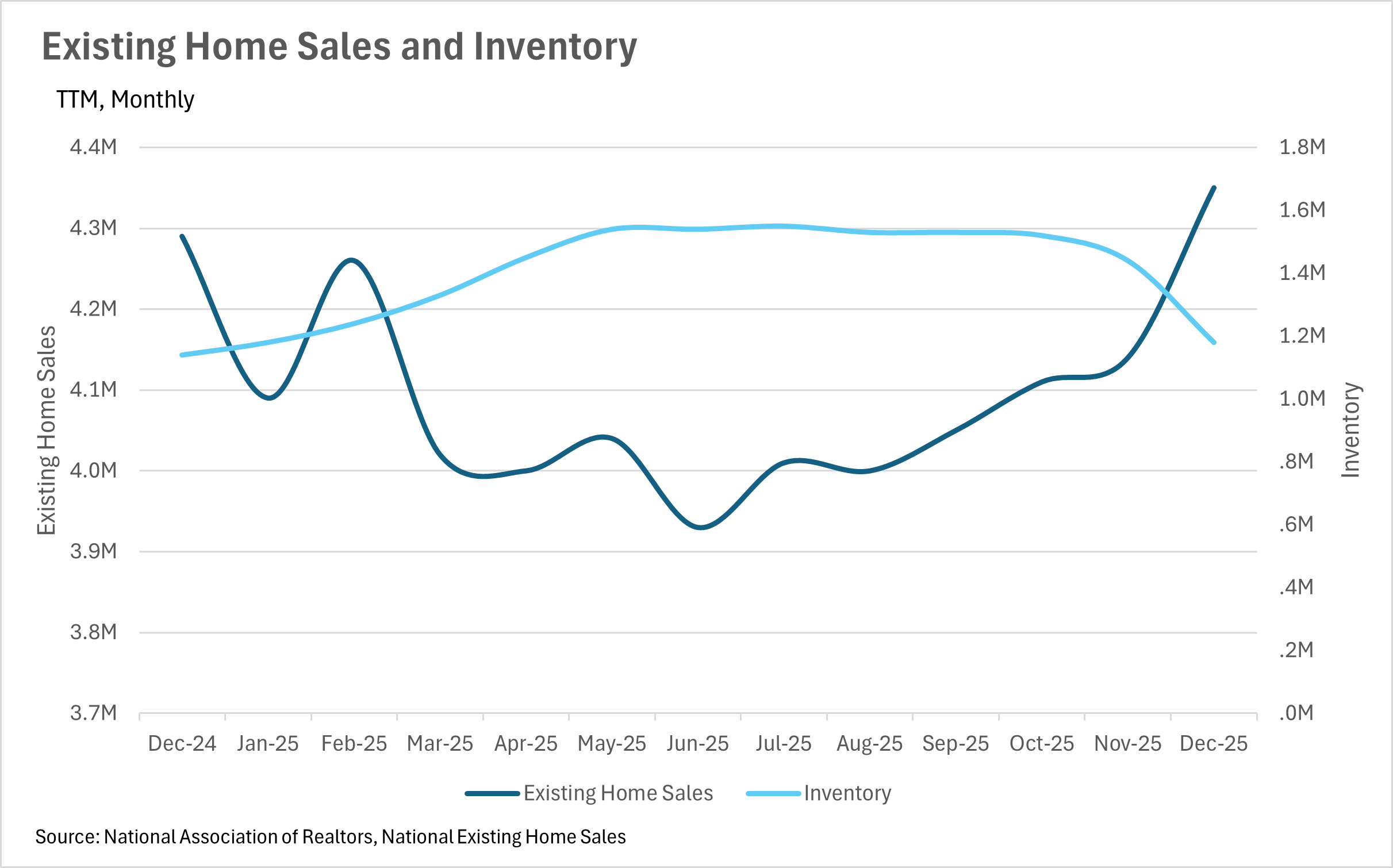
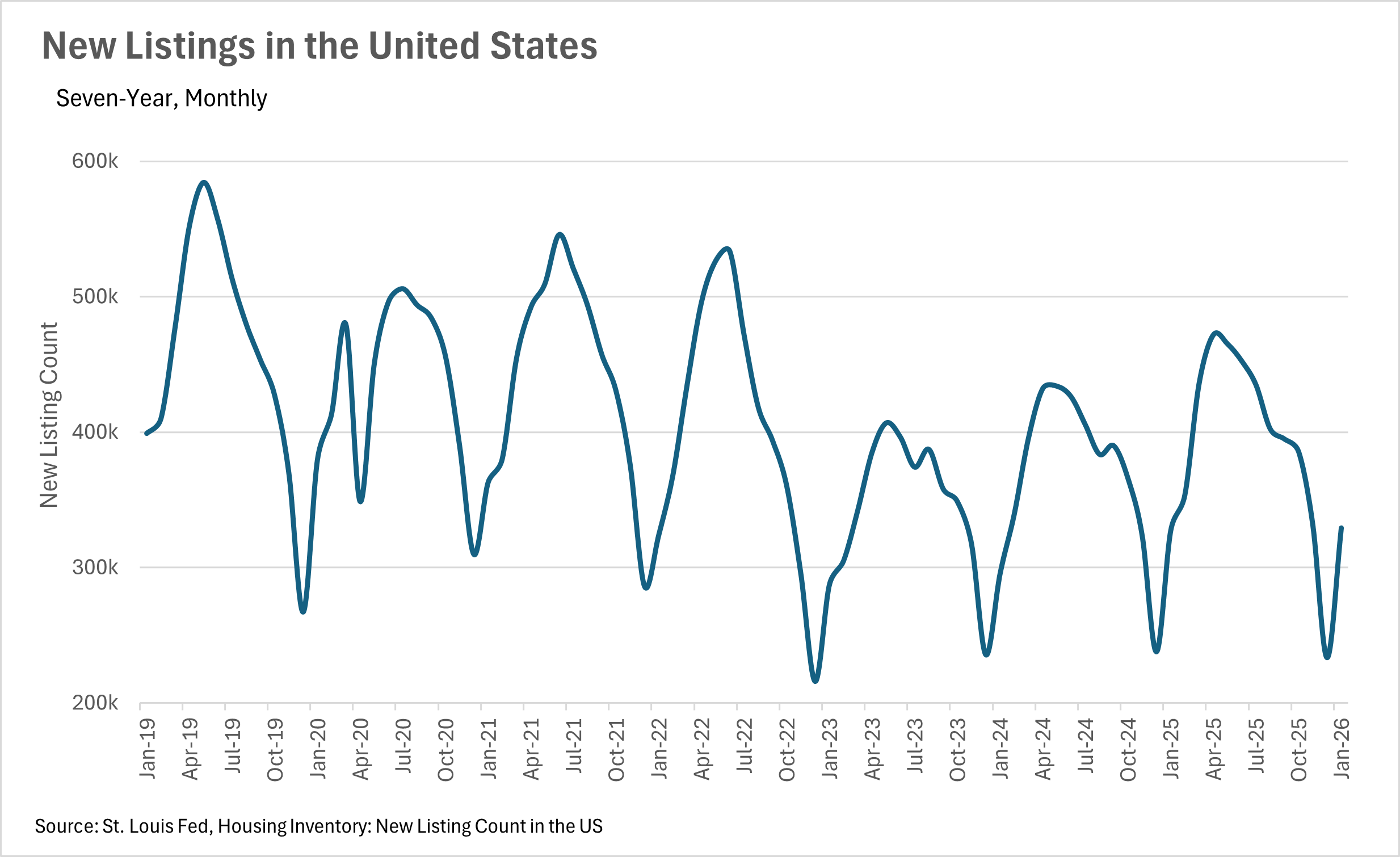
Although interest rates are coming down, and housing is becoming more affordable, we’re not seeing much change in terms of inventories, new listings, or existing home sales. Existing home sales and inventories are up 1.40% and 3.51% on a year-over-year basis, respectively. At the same time, new home listings are up just 0.68% on a year-over-year basis. This suggests that there are still a lot of buyers waiting on the sidelines for rates to come down even more before they pounce on their next home. It’ll be worth paying attention to all of the metrics we track as we move through the seasonally slow winter and into the spring and summer when the market really heats up. If we see a rate cut or two prior to the first heat wave of the year, we could see some bidding wars throughout the summer!
We’re likely to see rates stay where they are in the near term
As we mentioned above, we are likely to see rates stay where they are at least in the next FOMC meeting or two. While there was some speculation that the next appointed Fed Chair would create a Fed that is less autonomous in it’s decisions, the market does not believe that future Chairman Warsh will be the wildcard that many were anticipating. This can largely be supported by the fact that we’ve seen precious metals sell off precipitously recently, as these are typically considered a hedge when the dollar is less-than-stable. However, only time will tell, which means it’ll be more important than ever to pay attention to Fed commentary!
It’s important to note though, that all of this is what we’re seeing at a national level. As we all know, real estate is a highly localized asset, which is why you should check out what’s going on in your local market below in the Local Lowdown!
Big Story Data
The Local Lowdown
Quick Take:
-
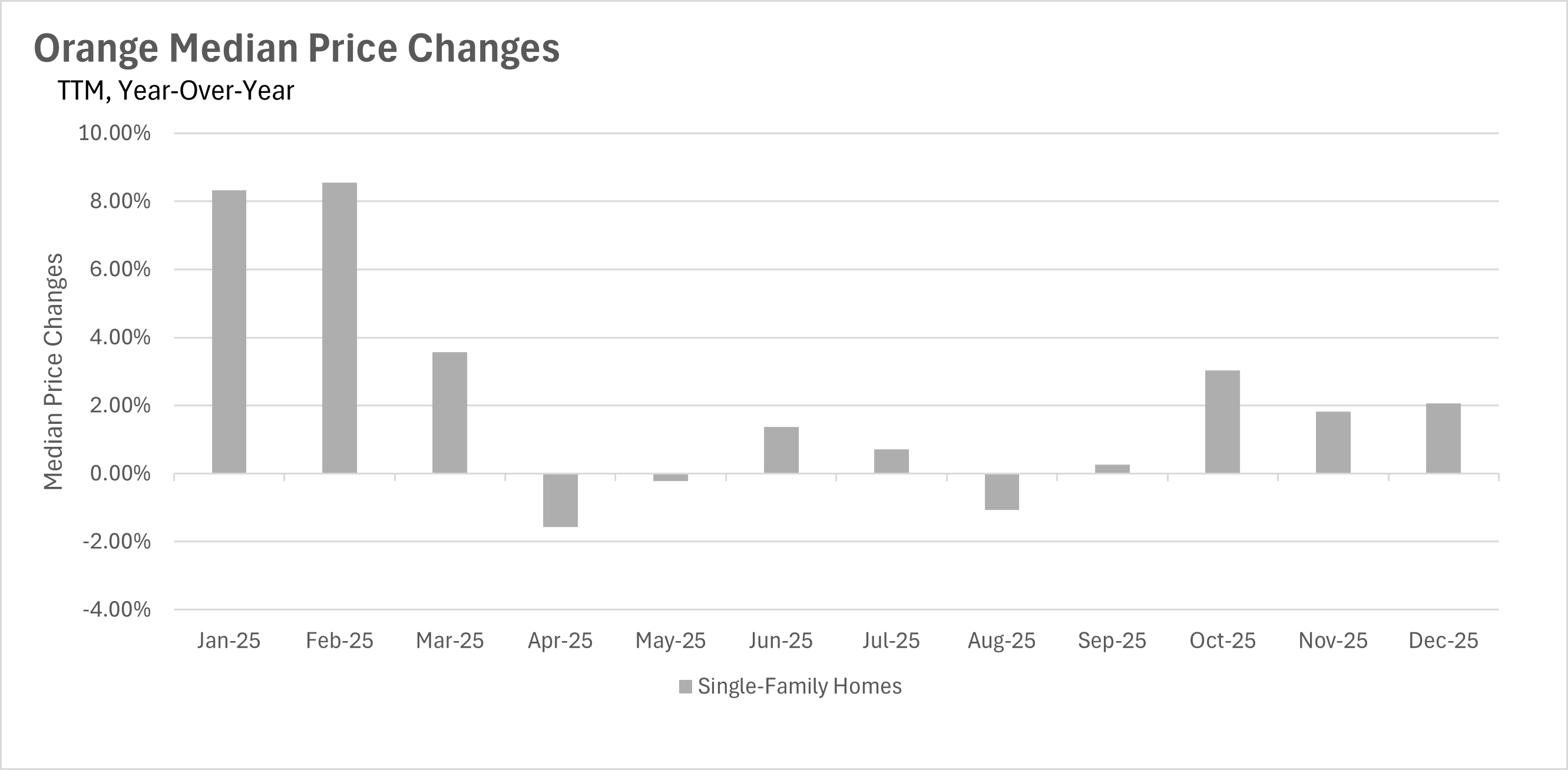
Median sale price growth has returned to positive territory, with single-family homes appreciating by 2.06% on a year-over-year basis in December.
-
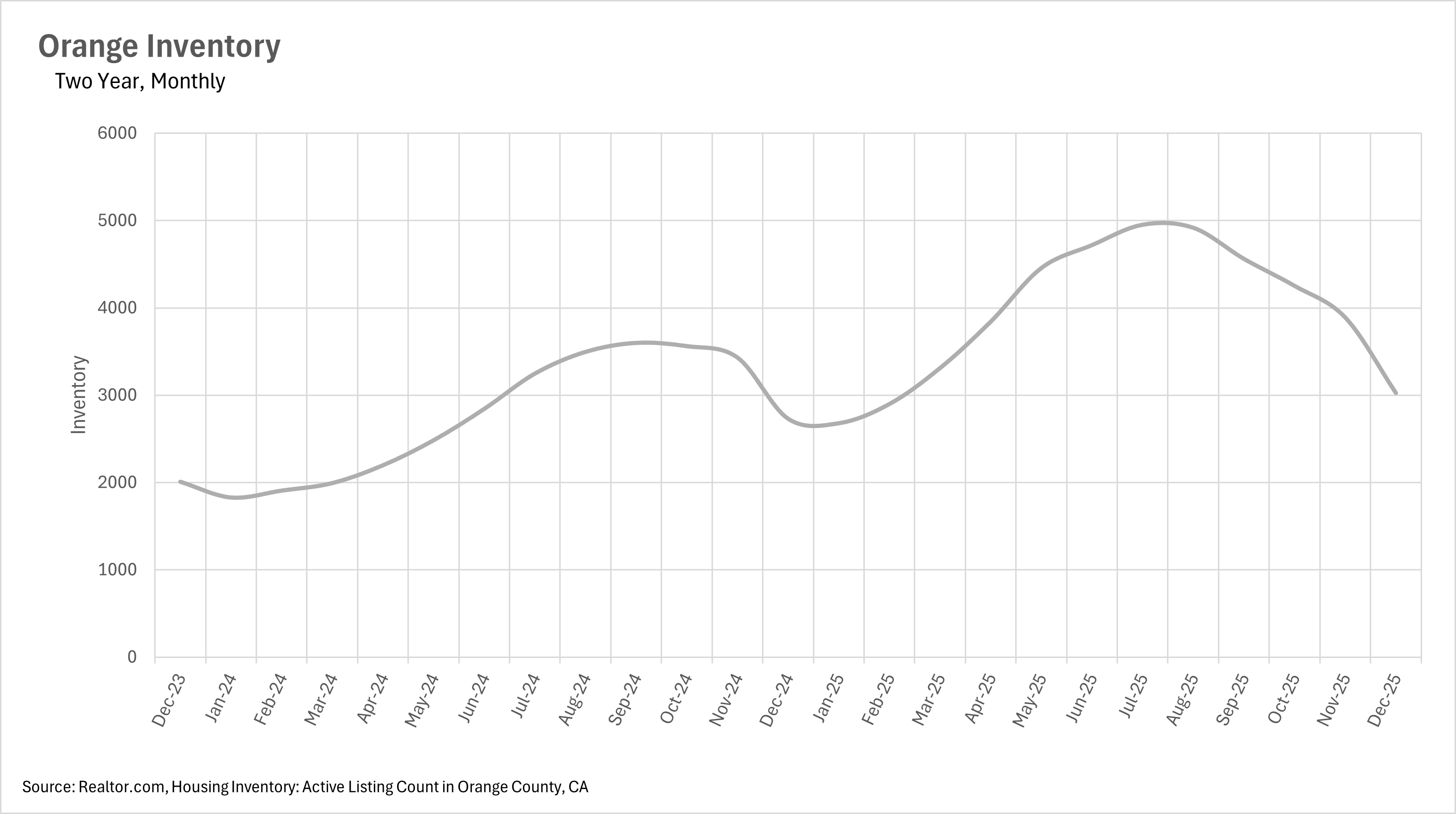
Inventory levels remain elevated compared to last year, with 10.80% more active listings on the market as of December.
-
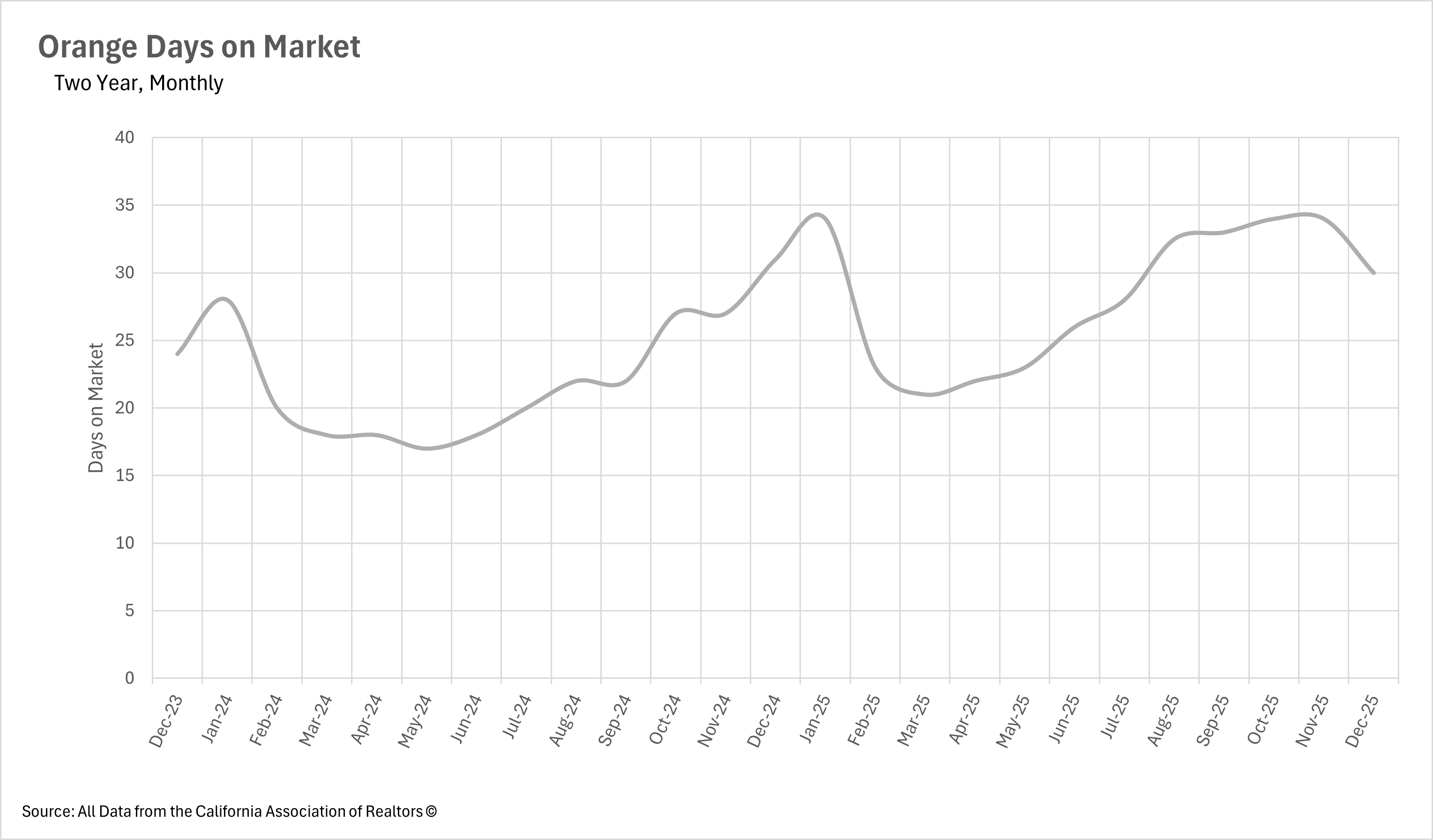
Despite elevated inventory, listings are actually spending slightly less time on the market than they were a year ago, with the median listing sitting for 30 days.
Note: You can find the charts/graphs for the Local Lowdown at the end of this section.
Orange County sale prices close out the year on a high note
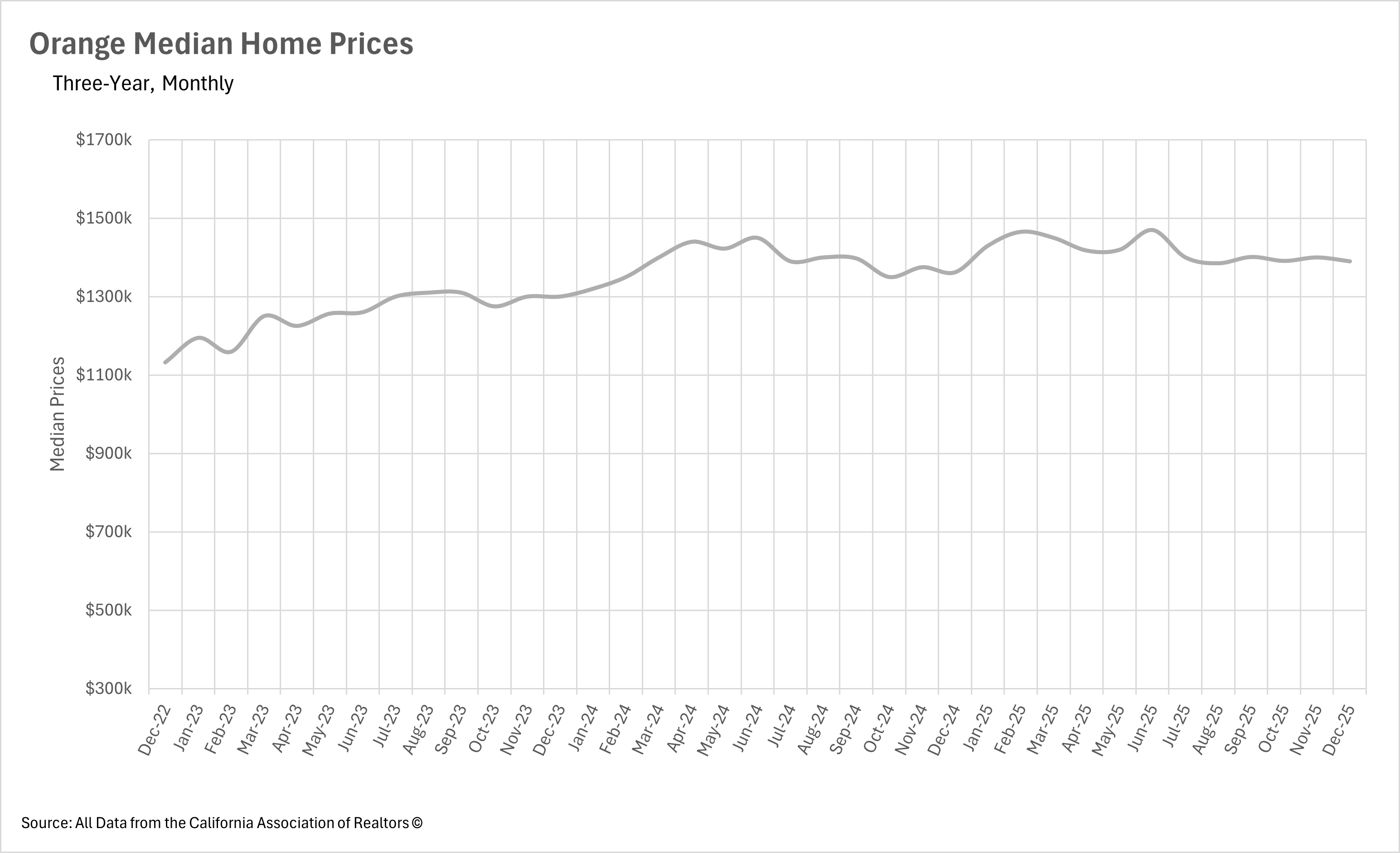
After a somewhat turbulent middle of the year, where we actually saw a couple of months of year-over-year price declines, Orange County finished the year with some solid momentum. The median single-family home sold for $1,390,000 in December, representing a 2.06% year-over-year increase. While this growth rate is certainly more modest than the 8%+ gains we saw at the start of the year, it's encouraging to see prices trending in the right direction after dipping into negative territory from April through May and again in August. For context, appreciation has now been positive for four consecutive months, with October leading the way at 3.04%, followed by November at 1.82%, and December rounding things out at 2.06%.
Inventory levels remain well above last year, despite a seasonal pullback
As we head into the winter months, it's normal to see inventory levels decline, and that's exactly what we saw in December. The number of active single-family home listings on the market dropped to 3,027, representing a substantial 22.19% decline on a month-over-month basis. However, even with this seasonal contraction, inventory is still 10.80% higher than it was this time last year. To put the full year in perspective, inventory peaked during the summer months, with July topping out at 4,952 active listings before steadily declining through the end of the year. This seasonal pattern is completely normal, but the fact that inventory remains elevated on a year-over-year basis means that buyers still have more options than they did at this point in 2024.
Listings are moving at roughly the same pace as last year
In a somewhat surprising development given the elevated inventory levels, the amount of time that listings are spending on the market has actually decreased slightly on a year-over-year basis. In December, the median single-family home listing spent 30 days on the market, representing a 3.23% year-over-year decline. This is also a notable improvement on a month-over-month basis, as November saw the median listing sit for 34 days. For much of the year, we saw days on market running well above last year's levels, so this recent convergence is a positive sign that demand is keeping pace with the additional supply that has entered the market.
Orange County ends the year as a seller's market
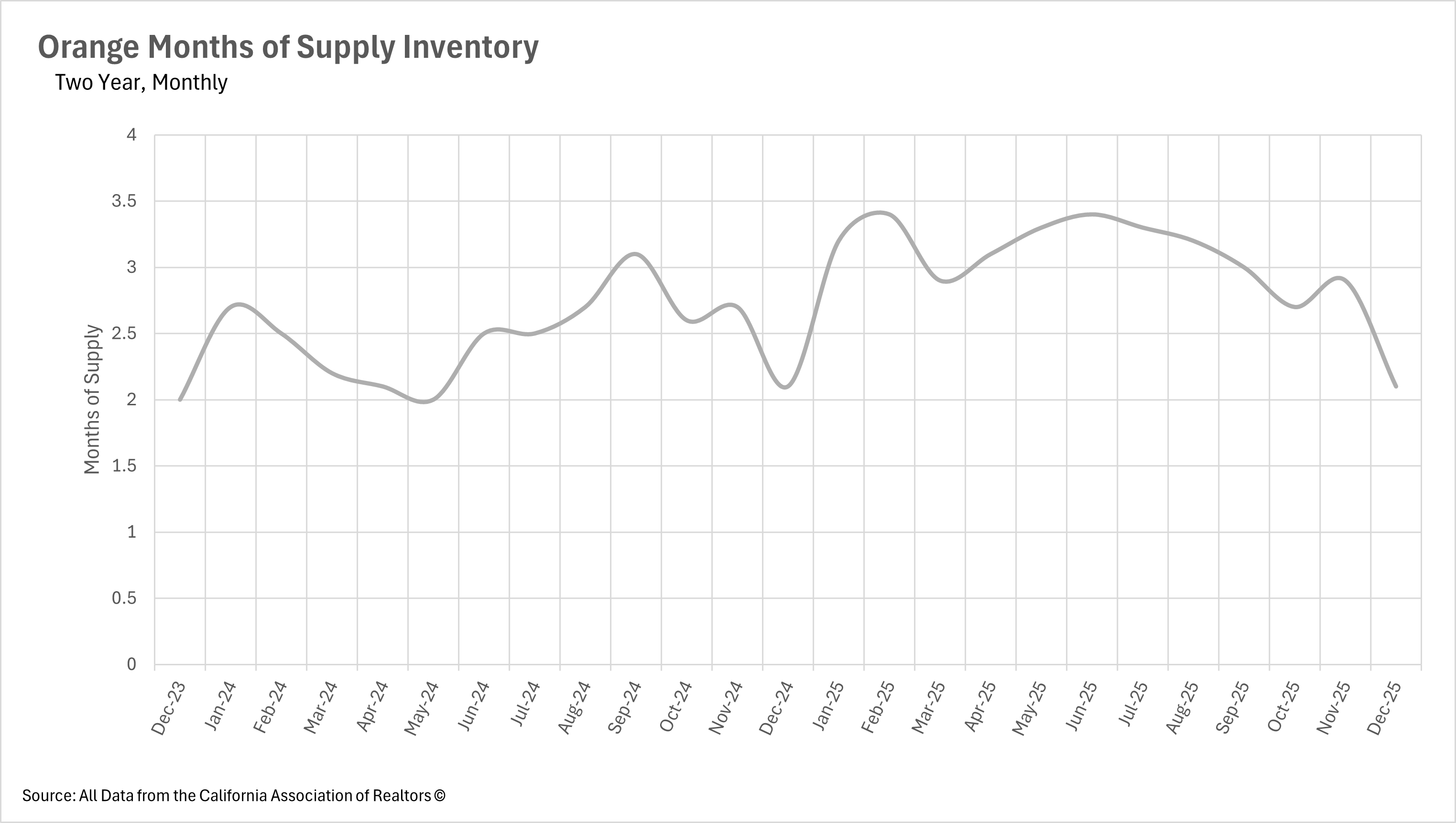
When determining whether a market is a buyers' market or a sellers' market, we look to the Months of Supply Inventory (MSI) metric. The state of California has historically averaged around three months of MSI, so any area with at or around three months of MSI is considered a balanced market. Any market that has lower than three months of MSI is considered a seller's market, whereas markets with more than three months of MSI are considered buyers' markets.
As of December, Orange County has just 2.1 months of supply on the market, placing it firmly in seller's market territory. This represents a significant 27.59% decline from November's 2.9 months of supply, and is flat when compared to December of last year. Interestingly, for much of the middle portion of 2025, Orange County was hovering at or above the three-month threshold, meaning it was technically a balanced or even a buyers' market. However, the seasonal contraction in inventory has pushed the market back into seller's market territory heading into the new year.